Second ACL Tears: Why They Happen and How Athletes Lower the Risk
The highest-risk period for an athlete’s ACL is not the injury itself. It is the first year after they return to sport following reconstruction. Research in the Journal of Athletic Training puts the risk of a second ACL tear in 10–25-year-old athletes at roughly 15 times higher than a healthy peer during the first 12 months back, and about 5 times higher in the second year. Knowing why that window is so dangerous, and what actually lowers the risk, is the difference between one recovery and a repeat surgery.
This article draws on a clinical presentation by Dr. Harrison Ogbewe, PT, DPT, SCS, MS, ATC/L, from the weekly PT Roundtable at Limitless Physical Therapy in the Eastern Panhandle of West Virginia.
How common is a second ACL tear after returning to sport?
Re-tear rates range from about 6% to 31% depending on the population and how long athletes are tracked. Longer follow-up shows the number climbing: studies report roughly 12% re-tears at 5 years, 27% at 10 years, and 31% at 15 years. The risk also splits two ways. A tear on the opposite (contralateral) knee is actually more common than one on the surgical (ipsilateral) knee, at about 11.8% versus 5.8%. That matters because prevention has to protect both legs, not just the one that was repaired.
Why is the first year back the highest-risk period?
Because re-injuries cluster in the earliest game and practice exposures, before the knee has re-learned to handle real competition. About 30% of second tears happen within an athlete’s first 20 exposures back, and more than half occur within 72. An “exposure” is a single game or practice, so that danger zone is only a few weeks of a normal season. The practical takeaway is that late-stage rehab has to rehearse on-field stress like cutting, landing, and decelerating, not just build strength in a straight line.
What makes some athletes more likely to re-tear?
A mix of who the athlete is and how they move. Age is the strongest single factor: younger athletes are at higher risk, and the risk drops by roughly 0.1% for every year of age. Graft choice matters too, since allografts (donor tissue) fail more often than autografts (the athlete’s own tissue). Beyond that, three movement patterns predict future injury:
- Increased hip internal rotation on the uninvolved leg in the first 10% of a landing.
- Increased knee valgus (the knee caving inward) on the surgical leg.
- Asymmetry in how the two knees absorb force at the moment the foot hits the ground.
Combined, those markers identified future ACL injuries with about 92% sensitivity and 88% specificity in the research. In plain terms: how an athlete lands and cuts is measurable, and it flags risk before a tear happens.
Can a second ACL tear actually be prevented?
Yes, and the evidence is strong. The FIFA 11+ warm-up program, done fully twice a week, reduces ACL injuries by about 50% and all injuries by about 39%. It works by training the exact patterns that predict re-injury: jogging with hip control, jumping and landing mechanics, single-leg balance, and planned cutting and planting. The point is not the specific drills. It is retraining the nervous system to control the knee under speed and fatigue, which is where tears actually occur.
What does ACL re-injury prevention look like at Limitless?
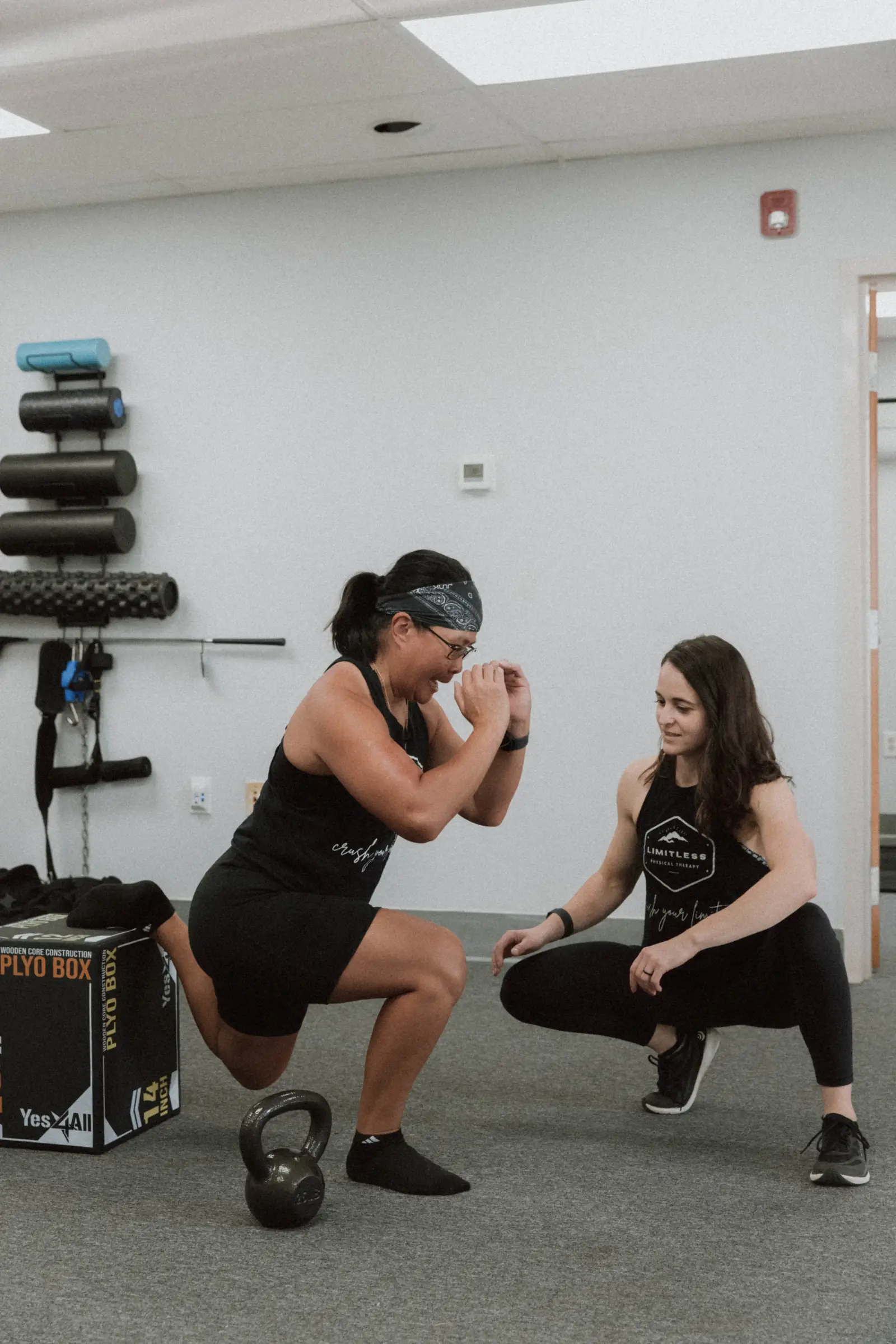
It looks like one-on-one, gym-based rehab that carries FIFA 11+ principles past the point most programs stop. Our first athlete through the ACL program returned to competitive soccer and is doing well, and that outcome came from training the hip rotation, quad control, and landing mechanics the research flags, not from a generic exercise sheet. In a full session with a doctor of physical therapy, we adapt team-based prevention drills into individual work: single-leg squats and Bulgarian split squats for quad and shin-angle control, Nordics and hip thrusts for posterior-chain strength, single-leg balance with perturbation, and controlled plyometrics that rehearse initial contact and toe-touch landing. Selection is based on where each athlete’s control is weakest, not a fixed template.
When should an athlete start re-injury prevention work?
Ideally before clearance to return, and definitely before the first 20 exposures back. Because so many second tears happen in those opening weeks, the prevention work belongs in late-stage rehab and the early return-to-sport phase, not as an afterthought once symptoms flare. Athletes across Martinsburg, Charles Town, Kearneysville, and the wider Panhandle who are approaching return to sport are the ones who benefit most from a movement screen at this stage.
The bottom line on avoiding a second ACL tear
A second ACL tear is common, most likely in the first year back, and driven by measurable movement patterns that respond to training. Structured prevention like the FIFA 11+ cuts ACL injuries roughly in half, and individualized late-stage rehab that rehearses real on-field stress is what protects both knees through the highest-risk window. If you or your athlete is recovering from an ACL reconstruction, a return-to-sport movement screen is the practical next step.
This article is general education, not medical advice, and it does not replace an individual evaluation. Talk with a licensed physical therapist or your physician about your specific injury and health history before starting or changing a rehab plan.