Dry Needling in Martinsburg, WV: What It Is, How It Works, and What to Expect
Dry needling in Martinsburg, WV is a physical therapy treatment that uses a thin, sterile filament needle to release a tight, irritable band of muscle called a trigger point. Nothing is injected. The needle creates a brief twitch in the muscle, and that twitch resets the muscle's resting tension, improves blood flow to the area, and calms the referred pain a trigger point can send to your head, shoulder, hip, or heel. At Limitless Physical Therapy, patients drive from Martinsburg, Charles Town, Shepherdstown, and across the Eastern Panhandle for it, and this guide covers what the treatment is, how it works, who it helps, and what a visit looks like.
What is dry needling?
Dry needling, also called trigger point dry needling or intramuscular stimulation, is a treatment where a licensed physical therapist inserts a solid filament needle into a myofascial trigger point. It is called dry because the needle carries no medication and no fluid. The target is a taut knot in a muscle that stays contracted, refers pain to other areas, and limits how far a joint can move.
A trigger point behaves like a muscle that forgot how to relax. Stretching rarely reaches it because the surrounding tissue stretches first. The needle goes directly into the knot, which is why dry needling often works on problems that months of foam rolling and stretching have not fixed.
How does dry needling work?
The needle provokes a local twitch response in the trigger point, and that twitch is the mechanism behind the relief. When the taut band twitches, three things happen: the muscle's resting tension drops, local blood flow increases, and the chemical irritants that keep the trigger point active are flushed out. Most patients describe the twitch as a quick cramp followed by noticeable relief.
Depending on the muscle, your therapist may run gentle electrical stimulation through the needle to amplify the release. Deep muscles such as the glutes, the deep hip rotators, and the muscles along the spine respond especially well to this, because they are hard to reach with hands-on pressure alone.
Is dry needling the same as acupuncture?
No. Dry needling and acupuncture use a similar needle, and that is where the overlap ends. Acupuncture is based on traditional Chinese medicine and treats along meridian lines. Dry needling is based on modern Western neuroanatomy and a hands-on examination of your musculoskeletal system. Your therapist chooses the needle targets by testing your movement and finding which muscles are driving the problem, so the treatment is tied to a specific physical diagnosis.
What does dry needling treat?
Dry needling treats pain and stiffness caused by muscle trigger points, which covers a wide range of complaints we see from Martinsburg patients every week:
- Neck pain and tension headaches, including whiplash and headaches that start at the base of the skull
- Jaw pain and TMJ dysfunction
- Shoulder pain from rotator cuff irritation, bursitis, impingement, or frozen shoulder
- Tennis elbow and golfer's elbow
- Low back and hip pain, including glute and deep hip tightness tied to disc problems
- Knee pain and tightness in the quads, hamstrings, or IT band
- Calf, shin, and plantar fasciitis pain that stretching alone has not fixed
- Sports overuse injuries in runners, lifters, and field athletes
- Post-surgical muscle guarding after a joint replacement or ACL repair
It pairs particularly well with the stubborn cases: neck pain that returns every few weeks, elbow pain that flares with every grip, and plantar fascia or calf pain that has outlasted the night splint.
What does a dry needling session feel like?
Most patients feel a quick, deep cramp when the needle hits the trigger point, then a loosening in the muscle within seconds. The needle itself is far thinner than the hollow needle used for a shot, so the skin puncture is usually barely noticeable. The twitch is the part people remember, and it typically lasts a second or two.
Expect mild soreness in the treated muscle for about a day afterward, similar to the soreness after a hard workout. Light movement, water, and heat help it fade. Bruising is uncommon but possible, especially around the shoulder and hip.
What should you expect at your first dry needling visit in Martinsburg?
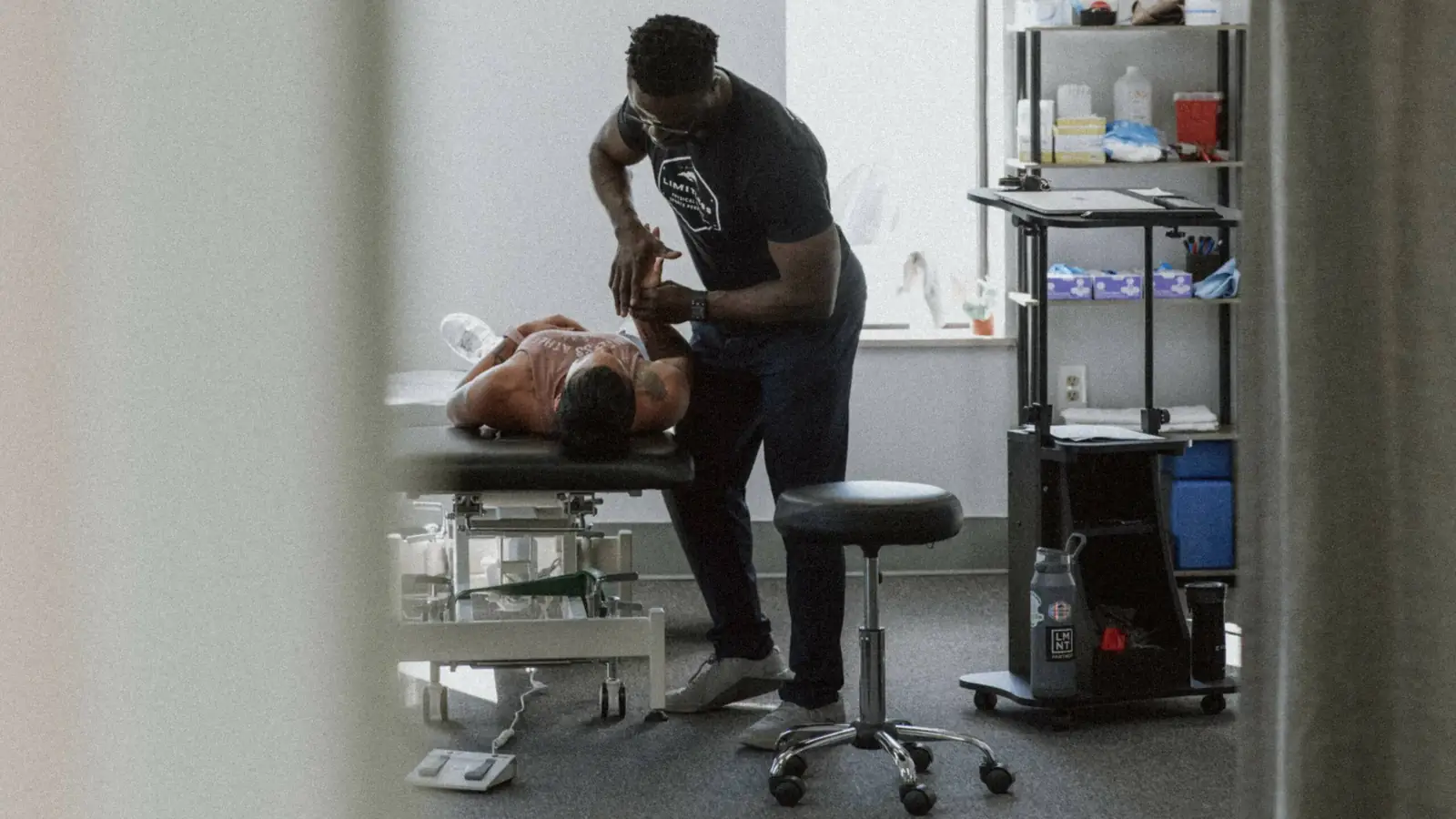
Your first visit at Limitless starts with a movement examination, not with needles. Your physical therapist tests how your joints move, finds which muscles are overloaded, and identifies the trigger points that are actually driving your pain. Only those targets get needled. Each visit is one-on-one with a Doctor of Physical Therapy for the full session, so the needling happens inside a longer treatment, not as a quick add-on.
Dry needling at Limitless is always paired with corrective exercise. Releasing a muscle without retraining the movement that overloaded it invites the trigger point back within weeks. You will leave with two or three specific exercises that keep the muscle long and the joint moving the way it should.
How many dry needling sessions does it take to feel better?
Many patients notice a change in range of motion during the first session, and lasting relief usually builds over a short series of visits spaced a few days to a week apart. A recent flare-up in one muscle group may resolve in two or three sessions. A chronic problem such as years of tension headaches or long-standing plantar fasciitis often takes longer because the surrounding movement habits also need to change. Your therapist will set a target at your evaluation and adjust it based on how you respond.
Who should not get dry needling?
Dry needling is not the right choice for everyone, and your therapist screens for this at your evaluation. It is generally avoided or modified for people who have a strong fear of needles, a bleeding disorder or blood-thinning medication, a local skin infection, lymphedema in the treatment area, or a compromised immune system. Pregnant patients can often still be treated with adjusted targets. If any of these apply to you, tell your therapist up front and the plan will shift to manual therapy, cupping, or instrument-assisted soft tissue work instead.
Who performs dry needling at Limitless Physical Therapy?
Dry needling at Limitless is performed by licensed Doctors of Physical Therapy trained through Evidence in Motion, and Dr. Kayla Rae DeWitt, PT, DPT holds Evidence in Motion Dry Needling Level 2 certification. Limitless is one of the most experienced dry needling providers in the Eastern Panhandle, and the technique is used every day alongside manual therapy, cupping, blood flow restriction training, and strength work.
Do you need a referral for dry needling in West Virginia?
No. West Virginia is a direct access state, so you can book a physical therapy evaluation at Limitless without a physician referral. Some insurance plans still require a referral for coverage, and the front desk at Limitless will verify your benefits before your first visit so there are no surprises.
Where can you get dry needling near Martinsburg, WV?
Limitless Physical Therapy is located at 362 W Burr Blvd, Suites 5-6 in Kearneysville, WV, about 15 minutes from downtown Martinsburg off Route 9 and a short drive from Charles Town, Ranson, Shepherdstown, Inwood, and Hedgesville. The clinic is open Monday through Friday with evening hours Tuesday through Thursday. To schedule a dry needling evaluation, call 304-407-4159 or request an appointment online, and if you are deciding between needling and another recovery tool, read our guide to dry needling vs. cupping.