Running Injury? How Physical Therapy for Runners Near Martinsburg Gets You Back on the Road

If running hurts, a physical therapist who works with runners will look at three things: the injured tissue, the way you run, and the strength behind your stride. Fixing only the sore spot tends to buy a few good weeks before the same pain returns. With Thanksgiving turkey trots on the calendar and winter base-building ahead, this guide covers the most common running injuries, what a running gait analysis shows, and how runners from Martinsburg, Charles Town, Shepherdstown, and across the Eastern Panhandle get back on the road at Limitless Physical Therapy in Kearneysville.
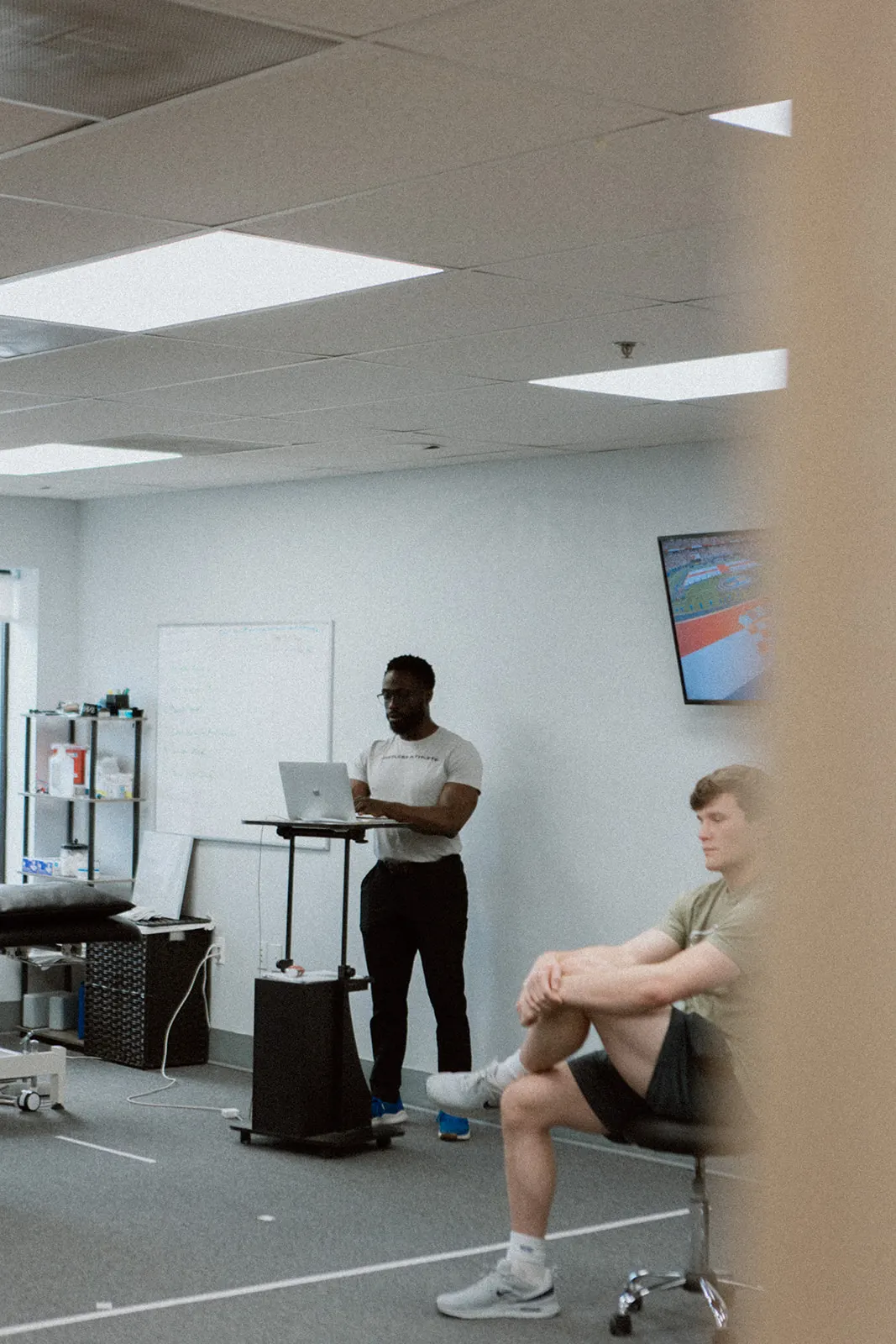
This article draws on two clinical presentations by Dr. Kayla Rae DeWitt, PT, DPT, a RunDNA Level 2 Certified Running Gait Analyst, from the weekly PT Roundtable at Limitless Physical Therapy: Strength Training for Runners and Running Gait Deviations and Analysis.
What running injuries does physical therapy treat?
Physical therapy treats most overuse injuries that show up in runners, along with the strains and sprains that come from a bad step. Common ones include:
- Knee pain, especially pain around or behind the kneecap. See our page on hip and knee pain.
- Plantar fasciitis and heel pain. See plantar fasciitis.
- Achilles and other tendon problems. See tendinitis.
- Foot, ankle, and shin pain, including irritation along the outside of the foot. See foot and ankle pain.
- Hip and glute pain that builds over a long run.
Each of these hurts in one spot, but in runners the cause usually sits somewhere else in the chain, and that cause is what a performance-focused physical therapist goes looking for.
Why do running injuries keep coming back?
Running injuries come back when the tissue heals but the load that overwhelmed it stays the same. Rest calms the pain. It does not change your stride, your strength, or your training plan, so the first long run after a break puts the same stress on the same spot.
In Dr. DeWitt’s roundtable on gait analysis, glute and core weakness came up as the most common theme across almost every running gait deviation, largely because many runners never strength train. Weak hips and trunk let the knee, foot, and lower leg absorb forces they were not built to handle mile after mile.
What is a running gait analysis?
A running gait analysis is a video-based look at how you run, matched against what your body can and cannot do on the table. The clinician records you running, slows the footage down, and checks how your foot lands, where your knee travels, how much your pelvis drops, and how much you bounce. Then they test the mobility and strength that explain what the video shows.
Clinics can do this with full 3D motion capture or with 2D slow-motion video, which is practical in a clinic setting. The goal of either method is the same: find the deviation, then trace it back to a mobility or motor control deficit you can actually train.
At Limitless, gait analysis is part of our sports performance care. If you run, we look at your gait, your mileage, and your training plan, not only the painful knee or foot.
What running form problems does a gait analysis find?
Most runners fall into one or more recognizable patterns. The five covered in Dr. DeWitt’s roundtable:
- The overstrider. The foot lands well in front of the body, with the ankle ahead of the knee at foot strike. This often goes with weak back and hip extensors and can feed front-of-knee pain or plantar fascia flare-ups.
- The collapser. The hip drops and rotates inward and the knees come together during the stride, with no visible gap between them. This puts more strain on the inner knee and kneecap and is often tied to glute and oblique weakness.
- The bouncer. Too much up-and-down motion, defined as more than 10 centimeters of vertical oscillation. Bouncers often have tight hip flexors that limit glute activation, and they are frequently older runners with reduced hip mobility.
- The weaver. A narrow, crossover step that can wear the outside of the shoe and strain the outer bones of the foot.
- The glute amnesiac. Weakness in the gluteus maximus that makes the runner lean toward the weak side to compensate.
Patterns often show up together. Overstriders are often collapsers too, and bouncers often show the glute amnesiac pattern. In the clinic, collapsing and overstriding are the deficits we see most.
How does physical therapy fix a running injury?
Physical therapy for runners works on two tracks at once: calm the injured tissue, and change the strength and movement that overloaded it. A typical plan includes:
- Hands-on treatment such as manual therapy or dry needling to reduce pain and restore motion.
- Strength work aimed at the deficit the gait analysis found, usually the glutes, hips, trunk, and calves, with extra work on the weaker side.
- Running retraining cues. A high-knee march on the treadmill can help an overstrider, and raising cadence with a metronome is an effective way to clean up overall running form.
- A load plan that keeps you running where possible, adjusting mileage and intensity while the tissue settles.
Every session at Limitless is one-on-one with a doctor of physical therapy, so the plan changes as your stride and symptoms change.
What strength exercises should runners do?
Runners do best with a short list of fundamental strength movements done one to two times per week, never daily, alongside their running. The seven movements from Dr. DeWitt’s strength-for-runners roundtable:
- Deadlift, built on a good hip hinge. A suitcase deadlift is a useful variation.
- Lunge, with attention to alignment.
- Squat, or a split squat as a variation.
- Single-leg sit-to-stand with weight, progressed by lowering the bench or adding load.
- Monster walks with a resistance band for glute activation and hip stability.
- Eccentric heel raises, which strengthen the calf muscles and help prevent and manage Achilles tendinopathy.
- Plyometric jumps, starting simple, such as jumping up from a seated position, and progressing toward shorter ground contact times.
Aim for about 5 to 8 controlled reps on the main lifts, scaled to your level. Control and good technique come before speed or heavy weight. Strength work also supports bone density, which matters for every runner and especially for women around and after menopause.
Is winter a good time for runners to start physical therapy?
Yes. Late fall and winter are a good time to get a nagging running injury looked at. Race calendars thin out after Thanksgiving turkey trots, which leaves room to fix a stride problem and add a strength block before spring training starts. Off-season strength work lets you build without giving up running entirely.
Runners who are healthy but want structure through the colder months can also keep training after discharge in our small group training, coached by the same clinical team.
When should a runner see a physical therapist instead of resting?
See a physical therapist when pain changes how you run, lasts more than a couple of runs, or keeps returning in the same place. Other good reasons to book an evaluation:
- Pain that starts at the same point in every run.
- Morning heel pain on your first steps out of bed.
- Swelling, or pain that lingers the next day.
- A training goal, like a spring half marathon, that a recurring injury keeps derailing.
Sharp pain, pain at rest, or pain on a specific spot of bone deserves prompt medical attention.
Where can runners near Martinsburg get physical therapy?
Limitless Physical Therapy is at 362 W Burr Blvd, Suites 5-6, in Kearneysville, WV, between Martinsburg and Shepherdstown. We see runners from Martinsburg, Charles Town and Ranson, Shepherdstown, and the rest of Berkeley and Jefferson counties. Wondering whether you need a doctor’s referral first? Read Do You Need a Referral for Physical Therapy in West Virginia?
Call 304-407-4159 or request an appointment to have your running injury and your stride evaluated.